
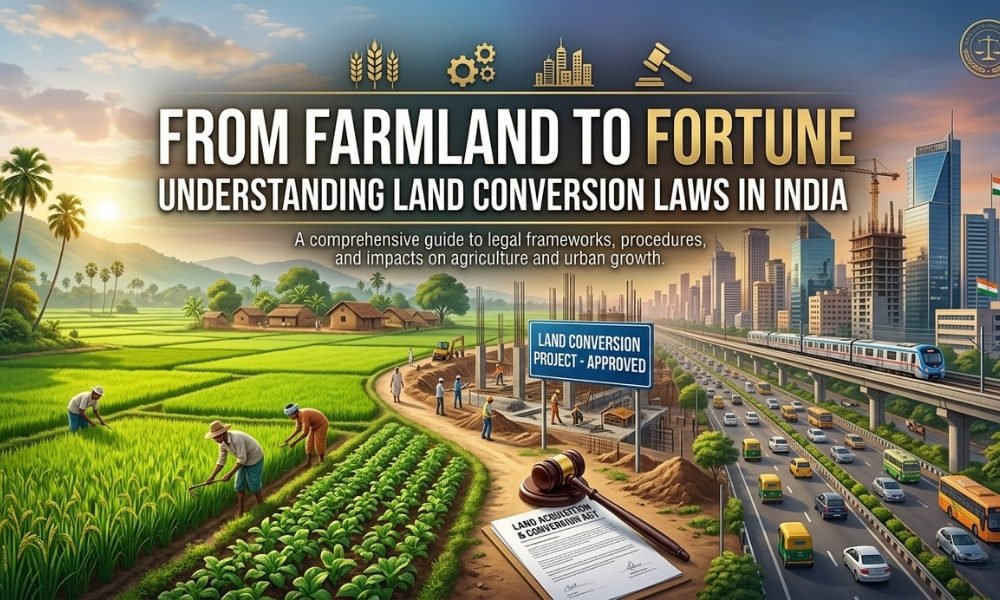
Legal Information: From Farmland to Fortune: Understanding Land Conversion Laws in India
Every Landholder / Investor / Developer Needs to Know How to Get From Agricultural Land to Development Land Legally
Waiting, you are finally seeing the value of that farmland starting to increase as urban growth has now extended into that previously rural area. A few years ago, it was merely farmland. Today, highways, industrial corridors, residential townships, and commercial complexes are developing around it, and there has been a huge change in present-day India
Its value has multiplied several times over.
But can agricultural land simply be used for residential or commercial purposes because the market demands it?
No, Agricultural Land will not legally convert to a residential colony, commercial complex, industrial unit, warehouse, or institutional use until there has been a legally recognised process of Land Use Conversion.
Understanding that process will not only help landowners/developers avoid disputes, will prevent them from incurring penalties and also prevent them from having delays in their project and costly legal mistakes when they are going through this conversion.
What is Land Conversion?
Land conversion is basically a legal pathway to take an agricultural parcel of land and get it used in a different capacity, like residential, commercial or industrial. In a nutshell :
Agricultural Land → Residential Land
Agricultural Land → Commercial Land
Agricultural Land → Industrial Land
Once an agricultural property has undergone the proper conversion process, any construction on the property would not be treated as being done without permission; therefore, the government will not issue any legal action against you for doing so.
Why is it Necessary to Convert Land?
Most people think when they buy land, it gives them free choice as to how they want to use it.
The number one mistake made by buyers of land in real estate is assuming that because they have purchased the land, they can use it how they wish.
Every piece of real estate in India is assigned a land type designation.
The Government regulates land types for various reasons such as for planned use of development, to protect the environment, and to maintain the overall management of the infrastructure of a property.
Therefore, changing the use of land generally requires prior approval from the competent authority.
The Dream That Often Turns into a Legal Nightmare
Consider this situation:
A buyer purchases five acres of agricultural land believing that a residential project can immediately be developed on it.
The buyer spends substantial amounts on:
Site development;
Boundary walls;
Marketing;
Construction planning.
Only later does he discover that the land has not been converted for residential use.
The project stalls.
Approvals become difficult.
Investments are blocked.
Disputes arise.
Unfortunately, such situations are not uncommon in India’s real estate sector.
Proper legal due diligence before purchase could have prevented the problem.
Who Grants Conversion Permission?
The authority varies from State to State.
Conversion Permits will generally be issued by the following types of agencies:
– Collector of District
– Deputy/Revenue Commissioner
– Tehsildars
– Development Authorities for Town Planning
– Urban Development Authorities
– Industrial Development Authorities
Each State has its own specific process and rules for conversion of land use depending on the legislation of the local authority governing conversion applications.
The following key documents will be required for conversion of land uses:
1. Title Documents
– Proof of legal title for land
2. Revenue Records (including):
– Khasra
– Khatauni
– Jamabdari
– Record of Rights
3. Site Plan (detailed map outlining properties and proposed developments)
4. Land Use Proposal (proposed use of property after conversion)
5. No Objection Certificate from Environmental Authorities and/or Utility Providers or Government Based Entities.
Legal Due Diligence: The Key to Success
Before purchasing agricultural land, an investor should confirm before the purchase of the property if he/she has adequate title documents for ownership, copies of revenue records verifying legal ownership, current classification of the land, whether there are encumbrances or restrictions from any government agencies and whether the property can be legally converted from use for agricultural purposes to some other purpose. Many disputes between buyers and sellers occur not due to insufficient title of ownership or defective title but due to lack of due diligence by buyers and sellers regarding the ability to legally process a conversion application and, therefore, to convert the property from use for agricultural purposes to another purpose.
Can Every Agricultural Land Be Converted?
Not necessarily.
Certain lands may be subject to restrictions.
Examples include:
Forest land, environmentally sensitive zone, flood-prone areas, Government land, Gram Sabha land
So, the possibility of change conversion must always be checked case by case, not just like in general, every single matter matters you know.
Advantages of agricultural land conversion
One of the reasons land conversions is much beneficial has it gives a dramatic change in value that often follows successful conversion.
A parcel of agricultural land may witness substantial appreciation once it becomes eligible for:
Residential development;
Commercial projects;
Industrial establishments;
Warehousing facilities;
Institutional projects.
Increases the market value
Substantial increase in market value
E.g.: Agricultural land is generally 2cr per acre, whereas when the same is converted to residential land, there is an increase of 500%; the price of the referred land will go up to a huge price, which is one of the main reasons that people generally convert that agricultural land for residential purposes to gain higher value.
(Indian Mart, Real Estate)
Common Mistakes Made by Land Buyers
Assuming Possession Equals Ownership
Possession alone does not guarantee title.
Ignoring Revenue Records
Most of the buyers never verify the Khasra or Khatauni entries made before the conversion or transfer of a specific agricultural land
Purchasing Based on Oral Assurances
Developers and brokers may make promises regarding future conversion that are not legally guaranteed. A proper and detailed study of the same is required by the buyer, as the process of conversion of the land is quite difficult if there isn’t proper guidance.
Delaying Legal Consultation
Trying to get legal advice after trouble has already kicked in is usually more costly than making sure, things don’t go sideways in the first place.
In the middle of all this, the real estate environment is changing, kind of fast. India’s urban sprawl, the rise of industrial stretches, big infrastructure developments, and smart city schemes keep turning those older agricultural belts into working economic centers.
And as this shift speeds up, figuring out land conversion regulations becomes more and more important for the following:
Farmers;
Landowners;
Investors;
Developers;
Real Estate Companies;
. Financial Institutions.
The future of real estate development is closely tied to compliance with land-use regulations.
Land conversion is far more than an administrative formality—it is the legal bridge between agricultural ownership and development potential.
For some, a parcel of farmland may remain an agricultural asset.
For others, it may become the foundation of a residential township, industrial park, commercial centre, or investment opportunity.
Understanding the laws in the property sector can make the difference between investment success and failure.
Before making an investment in agricultural land or before beginning any type of construction activity, a thorough legal due diligence and professional advice must be obtained.
The journey from agricultural land to an investment value of $$$$ does not begin with the development of the property but instead begins with complying with the laws governing your property.
How We Can Help You
LAWMARKA assists landowners, investors, developers, and businesses in the following areas:
a. Agricultural land transactions
b. Title search and due diligence
c. Agricultural land conversion approvals
d. Revenue records and property maintenance
e. Property registration
f. Development permissions
g. Property disputes and litigation
Our team will assist you with all aspects of land conversion and property transactions from inception to conclusion.
By Law Intern
Suraj Kumar M A