
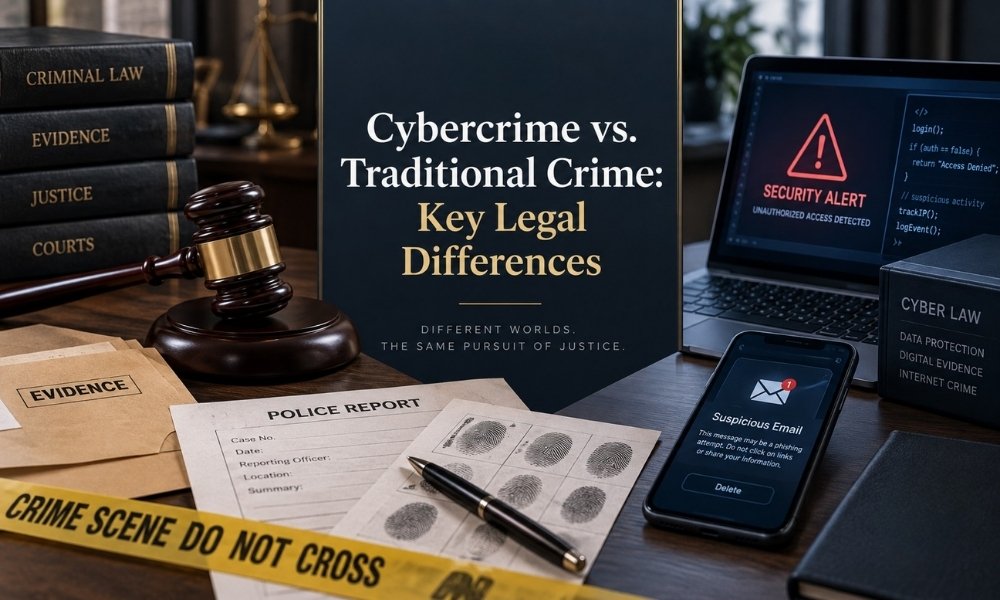
Cybercrime vs Traditional Crime: Key Legal Differences
The article Cybercrime vs Traditional Crime: Key Legal Differences reveals the essential effects of technology on crimes and law enforcement. In normal crimes, there are physical acts, locations, and interactions. Cybercrimes, however, take place using computers, networks, or the Internet, which often serve as instruments, targets, or means of committing the crime.
Thus, the article shows that knowledge of the differences between cybercrimes and normal crimes is vital for everyone, as it helps people and companies understand the risks they may face in this sphere, as well as the reasons why law enforcement agencies use specific techniques used for the investigation of online crimes.
Cybercrime vs Traditional Crime: Key Legal Differences in Location
Conventional crimes have a defined geographical area where they happen. Investigators frequently know the crime scene, the victim’s place, and the offender’s whereabouts.
In digital crimes, criminals can operate out of a different city, state, or even country and attack victims without being physically there. Hence, geography is less of a barrier for them.
The thesis proves that territorial issues are significant problems for the fight against cybercrime.
Cybercrime vs Conventional Crime: Important Legal Differences in Terms of Anonymity
One of the major differences is the identification of the perpetrator. Conventional crimes often provide information in the form of physical evidence, witness testimonies, etc. On the other hand, cybercriminals use different digital methods to remain anonymous. Besides, they can conduct their activities from any location and use advanced technologies to be undetectable. This paper points out the issue of anonymity as one of the biggest challenges for the prosecution of cybercrime. It also identifies technical difficulties and lack of cooperation as issues.
Consequently, investigators need to have advanced technical skills in order to identify cybercriminals.
Cybercrime versus Crimes Taken Place Before: Significant Legal Distinctions Related to Abstraction
One of the critical distinctions between the two is the identification of the criminal. Traditional crimes mainly provide humans with evidence such as physical evidence and witnesses who give testimony. In contrast, cybercriminals utilize various methods with a goal of hiding their identity. They can also commit their crime from any place and with the help of advanced technologies.
This research highlights the anonymity challenges related to cybercrime prosecution and the technological challenges, as well as the lack of collaboration.
Thus, it becomes essential for law enforcement officers to have technical knowledge.
Cybercrime vs Traditional Crime: Main Legal Distinctions in Types of Crimes
Traditional crimes are crimes that were developed before the rise of digital technology. Nevertheless, technology has allowed the execution of well-known crimes in a different way. For instance, criminals can commit fraud, forgery, stalking, as well as defamation online. Computers also enable committing completely new crimes that are based on technology.
These crimes can be illustrated by hacking, malicious software infection, ransomware, and denial-of-service attacks. This paper differentiates cyber-dependent crimes from cyber-enabled crimes.
The latter is a traditional crime that became available thanks to modern technology, while the former requires IT technologies for its functioning. Accordingly, the distinction is important for understanding the essence of the crime.
Cybercrime vs Traditional Crime: Key Legal Differences in Motive
Despite the fact that motives for both traditional crime and cybercrime can often be similar in nature, the perpetrators can still commit their wrongdoings due to various sets of reasons, namely greed, revenge, thirst for power, ideology, or personal hatred.
When it comes to cybercrimes, the perpetrators have the benefit of making use of cyberspace, which opens doors to unparalleled possibilities with regard to reaching out to the victims.
The dissertation identifies accessibility, the level of complexity of the system, weaknesses associated with the use of electronics, as well as all relevant human factors.
Thus, organizations must tackle issues relating to both the technological aspects of committing cybercrimes and the human error aspects in doing the same.
Legal Setting for Cybercrimes in India
The most crucial law used by India in dealing with technology crimes is the Information Technology Act, 2000. Through this law, e-transactions and digital communications have also been promoted. Furthermore, the Indian Penal Code also incorporates provisions regarding cybercrime. The thesis elaborates on the relationship between the Information Technology Act and traditional criminal laws.
However, the ever-evolving technology imposes various new challenges on investigators and the judicial system. Locked out of your office? 735 + 745 =?
Cybercrime versus Conventional Crime: Major Legal Variations
Understanding Cybercrime versus Conventional Crime: Major Legal Variations has become more critical today than ever before. Cybercrime transcends borders, conceals criminals, and creates complicated problems with evidence.
On the other hand, conventional crime normally occurs in distinct physical locations and relies on traditional investigative methods. As a result, cybercrime requires greater technical skills, legal coordination, and investigative skills.
Ultimately, Understanding Cybercrime against Conventional Crime: Major Legal Variations shows why it is essential for modern criminal justice systems to adapt continuously. Well-established laws, adequately trained law enforcement agencies, and raising awareness among the public can enhance India’s response to cybercrime.