
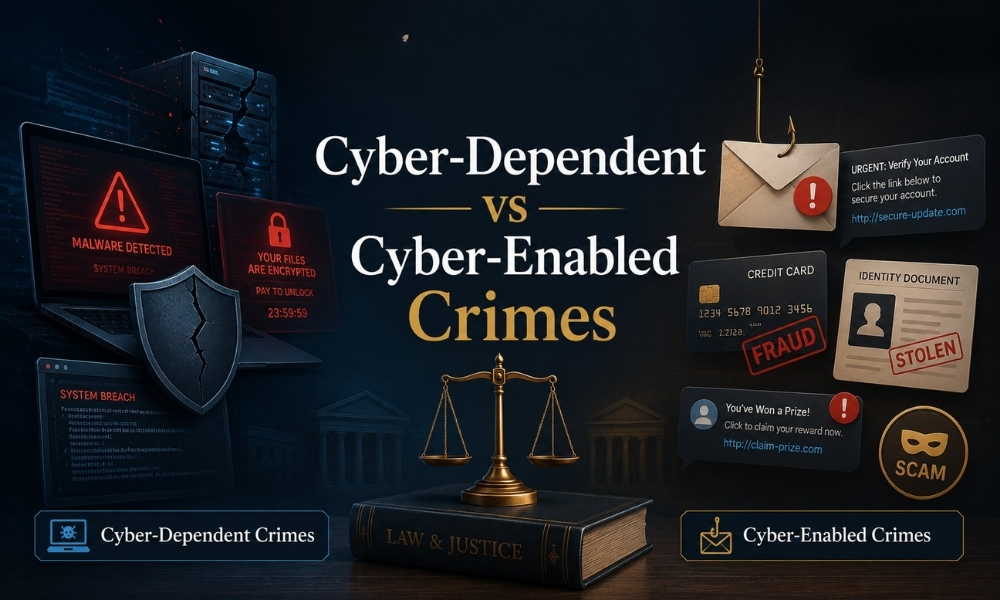
Cyber-Dependent vs Cyber-Enabled Crimes
The distinction between cyber-dependent crimes and cyber-enabled crimes is an issue of great importance in the modern digital era. Every day, businesses, professionals, and people are making use of technology. As a result, cyber criminals keep finding new ways to gain access to their systems. Hence, learning about the difference between understanding cyber-dependent vs. cyber-enabled crimes helps individuals stay aware of threats and strengthen cybersecurity. Besides that, this knowledge helps in the maintenance of compliance with laws.
Understanding Why the Difference is Important
People often confuse the two types of cyber crimes. Nevertheless, people must realize that the two crime types differ in terms of their purpose and methods. Cyber-dependent crimes only exist due to the existence of networks and computers. On the other hand, cyber-enabled crimes are a way of making use of technology in order to facilitate crimes that existed before computers came into our lives.
Understanding the major differences between the two crime types enables businesses to improve their security measures against crimes of this type.
1. Nature of the Offense
The first point of distinction in Cyber-Dependent vs Cyber-Enabled Crimes comes in the form of the nature of the said crime.
Cyber-dependent crimes are those that always rely on some kind of computer, software, or internet in order to be committed. Such crimes cannot exist in the absence of technological advances. Some examples of such crimes are malware, ransomware, and hacking.
On the other hand, cyber-enabled crimes are those which use technology to commit traditional crimes on a large scale. These crimes include online fraud, identity theft, hacking, etc. Essentially, criminals exploit the power of technology to reach a larger number of people.
As such, we can say that the difference between these two types of crimes is that cyber-dependent crimes refer to crimes that exploit the weaknesses of digital systems, whereas cyber-enabled crimes use technology to commit crimes very old in nature.
2. Target and Purpose
The next important thing to know when comparing the two categories of crimes is the objective of the crime.
In the case of cyber-dependent crimes, criminals tend to target computer systems, servers, and other computer applications/systems to accomplish their goals. The objective of such crimes is to gain control of others’ computer systems, servers, and other information.
On the other hand, when it comes to cyber-enabled crimes, criminals often target individuals or organizations to achieve their goals. The objective in this case is to make money through fraud and deceit. They communicate with their victims through technology rather than targeting the system itself.
Thus, the above comparisons clearly point to the fact that if we examine the motivations of criminals, it will help us detect risks and plan better.
3. Criminals’ Strategies
Techniques utilized by offenders provide a clear difference between Cyber-Dependent and Cyber-Enabled Crime types.
Cyber-dependent offenders create corrupt software, take advantage of software weaknesses, and evade security. They’ve got advanced tech abilities, and they use them to slip into information systems, quietly, almost like a shadow. On the other hand, cyber-enabled offenders rely on deception and manipulation in a big way, more often than people realize. They make websites, write deceptive emails, present misleading advertisements, and conduct social engineering campaigns that make people reveal sensitive information voluntarily.
Additionally, criminals keep improving their techniques, and therefore companies need to update their security awareness programs regularly.
4. Investigation and Evidence
Investigations are another major difference in the case of Cyber-Dependent and Cyber-Enabled Crime.
Cyber-dependent investigations need a lot of technical analysis. Investigators analyze system logs, virus samples, server activity, and data traffic. Digital forensics experts play a major role during those investigations.
The investigations of cyber-enabled crime concentrate on financial transactions, correspondence, identification, and digital evidence. Law enforcement agencies usually work together with banks, payment services providers, and various online platforms.
Also, investigators pay great attention to the collection of digital data.
5. Risk Prevention and Management
The last comparison between both types of crimes concerns the way of managing risk.
Cyber-dependent crimes require various technological risks to be diminished through the use of firewalls, endpoint solutions, encryption, software changes (updates), and constant monitoring of operations. All of these measures are aimed at lessening vulnerabilities in systems.
In preventing cyber-enabled crimes, however, employee awareness and staff training are needed. Staff should be made aware of phishing emails, those odd, suspicious links, and fraud stuff, among other things. Authentication and identity verification are also effective in lowering the level of risk.
Moreover, regular audits of cybersecurity practices are crucial in counteracting threats. Recommendations in the area of cybersecurity should be reviewed on a regular basis.
Responsibilities in Terms of Law
Businesses and organizations must have an established framework of cybersecurity procedures. Thus, good policies will help reduce risk and comply with the requirements of law and regulations. Moreover, companies should have procedures in place to create incident response plans beforehand.
The Significance of Professional Legal Support
Legal experts play an important role in the establishment of cybersecurity readiness. They clarify what regulators expect and also provide assistance to companies involved in cyber incidents; in other words, they help a bit.
Furthermore, legal advisers collaborate with forensic experts and authorities. This teamwork fosters better evidence gathering and compliance with legal requirements. In addition, it helps to maintain the reputation of the company.
Thus, companies should think about engaging legal support in advance and prepare for cyber-related challenges.
A good grasp of the notions of cyber-dependent and cyber-enabled crimes is essential for responding to new threats to cybersecurity. While information technologies cause the two phenomena, they dramatically differ with respect to their nature, methodology, targets, and legal investigation. Thus, it is evident that companies need to put into practice both technical measures and compliance with laws. Continuous training of staff members, using updated IT technologies, and employing competent lawyers decreases the chances of attackers launching an attack.