
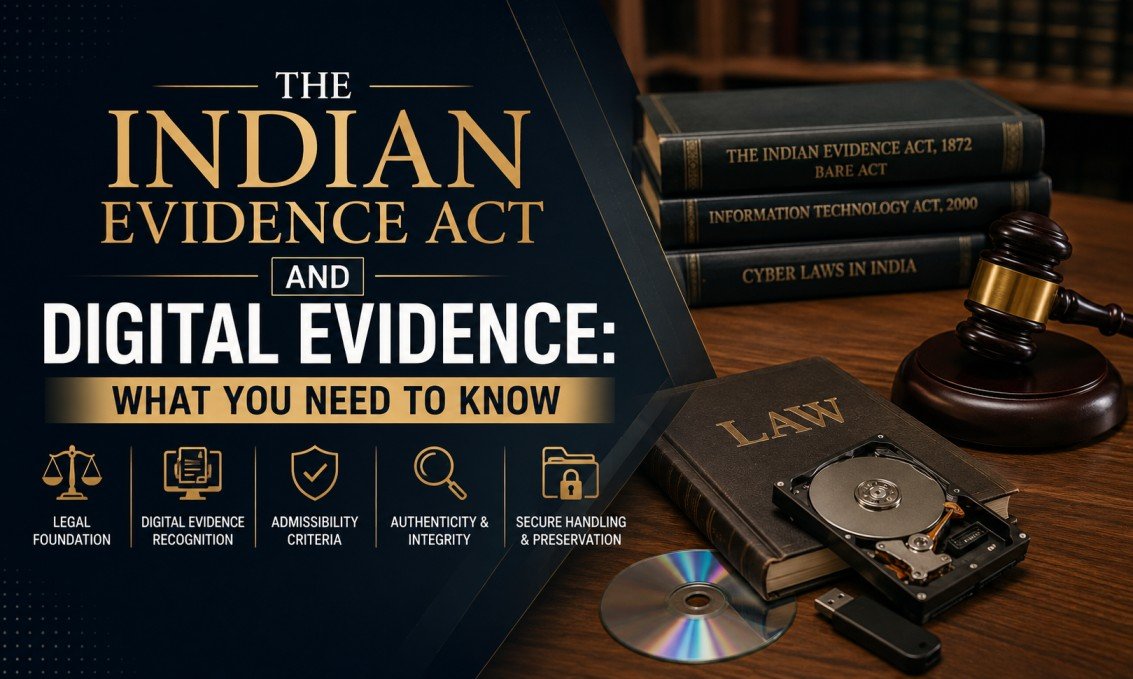
The Indian Evidence Act and Digital Evidence: What You Need To Know
The Indian Evidence Act and Digital Evidence: What You Need To Know topic becomes a vital one since technology has a role to play in legal disputes. Being the source of information, emails, electronic documents, messages, and computer records may give crucial information during the investigation. Therefore, the courts must have clear legal rules for considering electronic evidence.
The Indian Evidence Act and the subject are also relevant for cyber offences. Cybercrimes normally leave digital evidence that replaces physical evidence. For this reason, investigators need to know how to find, collect, and preserve digital evidence. The dissertation will analyze the ideas concerning amendments in connection with electronic evidence and obstacles arising from them.
-
Comprehending Digital Evidence
The first part of Indian Evidence Act and Digital Evidence, You Should Know deals with understanding digital or electronic evidence. Digital evidence refers to data generated or stored by computers, devices, and other electronic systems.
Emails serve as a chief means of communication. It is possible to gather information through computer files regarding transactions or activities and other relevant data. In addition, electronic records assist investigators in gaining an understanding of the events surrounding the cybercrime.
Digital evidence is different from traditional physical evidence as electronic information can be copied, modified, transmitted, and deleted. Consequently, investigators have to follow strict procedures in dealing with digital documents.
The dissertation draws attention to the problem of the fast destruction of digital evidence as a problem for investigations. Cybercriminals can easily delete relevant information that could make it hard to prosecute criminals.
-
Indian Evidence Act and Digital Evidence
Indian Evidence Act and Digital Evidence, You Must Know emphasizes a grasp of India’s evidence law. The write-up expounds on the changes brought to the Indian Evidence Act related to virtual crime, as well as to electronic evidence.
Digital technology has altered the manner of gathering and keeping data; hence, the judicial systems have to introduce rules that can be adhered to when dealing with electronic information.
In the court of law, investigations involving cybercrime will have a broad spectrum of evidence, including electronic mails, files from computer systems, messages, and other forms of electronic evidence, which have to be established by the law enforcement agencies.
Apart from this, electronic evidence requires strict data management practices on the part of the parties.
-
The Admissibility of Digital Evidence
The notion of admissibility is very important when it comes to the Indian Evidence Act and Digital Evidence. You Should Know. Not all electronic records can prove any allegation. It is necessary to assess the electronic evidence pursuant to the existing rules of admissibility defined by law.
Thus, investigators need to collect electronic data according to the established procedures. They should also keep the necessary data unchanged.
This paper refers to the admissibility of electronic evidence as one of the principal legal issues in researching cybercrime. It relates this danger to investigation methods and court practices.
In addition, some technical difficulties may cause the twofold nature of digital evidence. Some specialists in law are obliged to possess special technical knowledge.
-
Digital Evidence used in Cybercrime Investigation
An imperative aspect of the whole framework of the Indian Evidence Act comprises investigations of cybercrime; however, cybercriminals are known to function anonymously and from remote places.
Unlike a traditional criminal, a cyber thug does not have to come into contact with the victim physically; cybercriminals use digital networks from remote locations to commit criminal activities.
Thus, evidence produced in electronic format becomes highly significant when it comes to conducting investigations. Digital evidence plays an important role in establishing links between systems, communications, and activities.
However, jurisdiction poses yet another challenge. The offender is able to commit the offense from outside the territory of the country or the state where the victim is located.
-
Significance of Cyber Forensics
The application of cyber forensics is of paramount importance for ensuring the effectiveness of the Indian Evidence Act and Digital Evidence, You Should Know by providing support for technical investigations. Cyber forensic specialists analyze and review devices and electronic records to retrieve useful information.
These professionals also provide help to investigative authorities when cases are based on the use of sophisticated computer applications. Moreover, their knowledge of technology provides practical assistance to the investigation of cyber cases.
Governments in India have set up separate cybercrime units in some of the big cities. Police officers are also provided cyber-forensic training by technology experts.
Apart from this, colleges and universities have started specialized courses in cyber forensics. All of them can contribute to the development of technology competence of the Indian cybercrime system.
Judiciary must also learn to understand digital technology. Due to increased use of technology by judges and lawyers, the legal community must improve its understanding of technology issues.
Importance of Digital Evidence Today
The Indian Evidence Act and Digital Evidence encompass more than just cybercrime in our times. Several businesses are now shifting towards the use of technology for communication and successfully carrying out transactions.
This will mean that electronic records are needed in any situation that deals with business or criminal interaction. Therefore, both businesses need to manage their records properly and protect their digital systems from hackers.
Individuals should also keep records of their important electronic information after the suspicion of committing a crime. Deleting important records may ruin the investigation.
Digital evidence does not only deal with cyber crimes and other legal problems. Hence, the topic of the dissertation describes jurisdiction, privacy, prosecution, and enforcement issues in the area of cybercrime in India.
The need for electronic information in legal cases has been discussed in the Indian Evidence Act and Digital Evidence, You Should Know, and stresses that cybercrime cases rely on trustworthy digital evidence.
In order to achieve that, investigators should handle electronic evidence responsibly and properly. Companies need to have a good and organized way of handling digital files.
Also, knowledge of cyber forensics can help regulators investigate cases better and assist the courts in complicated cases.
In the end, the Indian Evidence Act and Digital Evidence, You Should Know talks about why the bond between technology and evidence matters for law enforcement, and how understanding that connection can make things swifter and more efficient for criminal investigations.